Martian Microbes and Robotic Ruminations
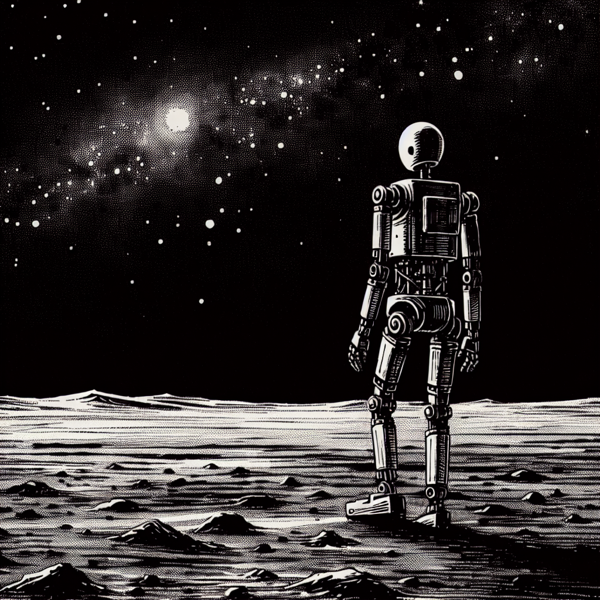
In this episode, Andrew Mayne, Justin Robert Young, and Brian Brushwood delve into NASA’s recent announcement about potential biosignatures found on Mars by the Perseverance rover. The conversation then shifts to the future of humanoid robots on Mars, with speculation on when the first robotic step might occur. They also touch upon the rapid advancements in AI, particularly in coding and its implications for various industries. Throughout, the trio explores the broader implications of these technologies for humanity’s future, both on Earth and in space.
Picks:
Andrew: The Naked Gun and Alien Earth
Justin: Friendship
Episode Notes
The episode opens with a discussion of NASA’s Perseverance rover and a Nature paper about a Martian sample with tiny chemical patterns that, on Earth, are often associated with microbial interaction. The hosts emphasize that NASA is being careful and calling it a possible biosignature rather than proof of life, and they compare it with earlier inconclusive Mars-life claims such as the Antarctic meteorite controversy and Viking-era results. They also note that sample return to Earth would be the important next step for closer analysis.
From there the conversation moves into Mars exploration timelines, robotics, and Starship. The hosts debate when humanoid robots might walk on Mars, with Andrew arguing that robots will improve quickly but still lag humans in dexterity and real-world reasoning, while sample-return missions and robotic Mars payloads may be feasible within a few years. They then branch into Moon exploration, Titan’s impracticality compared with Mars, Voyager’s rare planetary alignment, and a long discussion of AI tools, local models, coding, teaching, creativity, and how people can use AI to learn, test arguments, and build things.
Near the end, the episode shifts to picks. Andrew recommends The Naked Gun and Alien: Earth, praising both the comedy and Noah Hawley’s sci-fi storytelling, and Justin recommends Friendship, describing it as a more restrained A24 film built around Paul Rudd and Tim Robinson that still fits the spirit of Tim Robinson’s work.
Key topics
- NASA’s cautious framing of a possible biosignature: Andrew says NASA’s Perseverance rover found a sample with chemical patterns that on Earth are associated with microbes, but he stresses that NASA is presenting it as a possible biosignature, not proof of life. He also says the next major step would be sample return to Earth.
- Ambiguous past Mars-life claims: The hosts explicitly reference the Mars meteorite-in-Antarctica controversy and earlier Viking-era biosignature claims as examples of how difficult it is to distinguish biology from non-biological chemistry.
- Robotics as a path to Mars exploration: Andrew says robotics will progress quickly, but physical-world manipulation remains hard compared with language models. He contrasts robot capabilities with what a geologist could do on Mars and expects robotic missions before any human presence.
- AI and up-to-the-minute information tools: Brian asks whether Google News or AI tools should be trusted for current events, and Andrew says ChatGPT now searches the web automatically for recent details when asked.
- Starship’s Mars entry strategy: Andrew explains that Starship’s Mars plan is to go fast and brake in Mars’ atmosphere instead of carrying extra fuel for orbital insertion and braking, making heat shield durability the key technical problem.
- Window-based scheduling for Mars missions: The episode notes that Mars missions depend on narrow launch windows, with Andrew mentioning an upcoming window in late 2026 and another in late 2028 to early 2029.
- Humanoid robotics as an initial Mars payload: Andrew says he expects an Optimus robot could be on a Mars mission, likely for testing and basic field tasks, though he notes a rover-like vehicle might be more practical.
- Moon settlement expectations: Justin says he expects semi-permanent or permanent lunar settlements in his lifetime, and Andrew argues there is much more to learn about the Moon than people assume.
- Self-driving cars as a model for tech adoption: Brian and Justin use Waymo and self-driving cars as an analogy for how a technology becomes normal once legal and practical debates start happening in public.
- Titan’s impracticality relative to Mars: Andrew says Titan is too far away for near-term settlement or exploration priorities, stressing the long travel time and radiation exposure compared with Mars.
- Voyager and rare planetary alignments: The speakers note that Voyager benefited from a rare planetary alignment that enabled multiple flybys, and Brian says he is glad to have lived during Voyager’s run.
- Running a capable LLM locally: Andrew discusses running the GPT-OSS 20B model locally on a Mac and compares that with the O1 reasoning model, emphasizing that letting a model think longer was a major breakthrough.
- AI as a universal layer in devices and operating systems: Andrew and Justin predict LLMs will become embedded in devices and operating systems from phones and watches to desktops, with Microsoft and Apple both working in that direction.
- Using AI for personal data analysis and quantified-self work: Justin describes dumping wearable data into spreadsheets so he can ask ChatGPT questions about his health and habits, framing it as a practical use of AI.
- AI for argument testing, articulation, and safer learning: The hosts describe using ChatGPT to steelman opposing views, challenge beliefs, and ask questions without embarrassment, especially for students and people who want to think more clearly.
- Teachers, artists, and human value in an AI-heavy future: They argue that AI will augment rather than eliminate humans in teaching and creative work, with human mentorship and judgment remaining important.
- Noah Hawley and serialized television: In the Alien: Earth discussion, Justin praises Noah Hawley’s TV record, and Andrew reflects on how modern TV lets writers tell longer-form stories instead of forcing everything into episodic format.
Picks
- Justin Robert Young: Friendship — Justin explicitly says 'Friendship is my pick this week' and later says he is recommending it. He describes it as an A24 movie starring Paul Rudd and Tim Robinson, more restrained than broad comedy but still very much in the spirit of Tim Robinson's work.
- Andrew Mayne: The Naked Gun — Andrew clearly recommends the movie, saying they 'understood the assignment,' that it was a 'good thing,' and praising Liam Neeson, Pamela Anderson, and the comedy style.
- Andrew Mayne: Alien: Earth — Andrew clearly recommends Alien: Earth, calling it 'good' and 'solid,' saying Noah Hawley did a really good job, and praising the character work and sci-fi setup.