Asteroids, Quantum Computing, and Disneyland Adventures
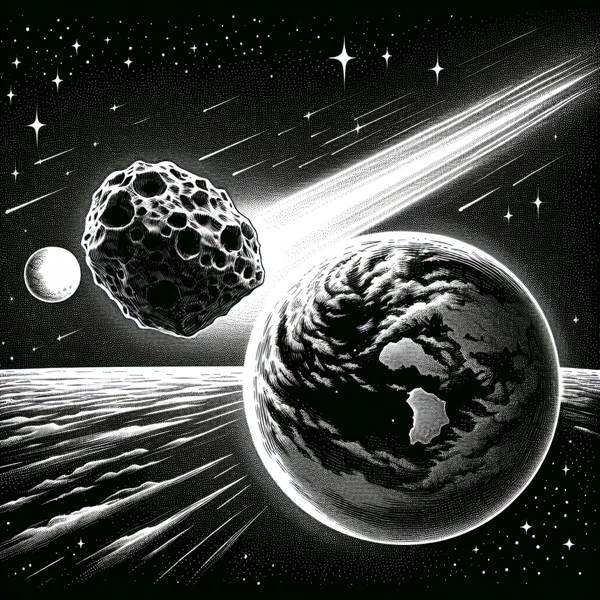
In this episode, Andrew Mayne, Justin Robert Young, and Brian Brushwood kick things off with a cosmic sigh of relief as the chances of an asteroid hitting Earth decrease. They ponder the implications of a moon impact, drawing parallels to sci-fi scenarios and historical events. The conversation then shifts to Microsoft’s announcement of a quantum computing breakthrough using exotic matter, sparking a discussion on the potential and current limitations of quantum computing. Andrew shares his recent Disneyland adventure, highlighting the magic of Rise of the Resistance and the charm of Mickey and Minnie’s Runaway Railway, contrasting it with his disappointment in Galaxy’s Edge.
Picks:
Brian: The First Fifteen Lives of Harry August by Claire North
Andrew: Disneyland, specifically Rise of the Resistance and Mickey and Minnie’s Runaway Railway
Episode Notes
The episode opens with the hosts discussing asteroid 2024 YR4, whose Earth impact odds have dropped, and quickly turns to the less certain but more interesting possibility of a lunar strike. They talk through the visible flash, dust, crater formation, and whether any ejecta could reach Earth, while Andrew reads from a Deep Research report estimating the object as a city-killer-sized asteroid and describing its effects on the Moon.
The conversation then ranges across moon impacts, the role of the Moon as a possible protective factor for life on Earth, reactions to disaster origin debates, and the usefulness of ChatGPT Deep Research as a citation-backed research tool. Later segments cover Microsoft's Majorana/topological qubit claims, current humanoid robotics announcements, a discussion of the uncanny design of the OneX robot, and several recommendations, including a time-loop novel and Disney rides.
Key topics
- Potential effects of a lunar asteroid impact: The hosts discuss what would happen if asteroid 2024 YR4 hit the Moon, including a flash visible from Earth, lunar dust and ejecta, crater formation, and the possibility of minimal debris reaching Earth.
- Shoemaker-Levy 9 and dramatic impact events: Brian cites Shoemaker-Levy 9 hitting Jupiter as an example of an impact event that was scientifically valuable and exciting to observe.
- The moon as a protective factor for life on Earth: Brian relays a book argument that Earth’s Moon may help shield the planet from extinction-level impacts, while Andrew offers a counterpoint that impacts can also accelerate evolution.
- Why disaster origin matters for future prevention: The discussion shifts to COVID and lab-origin debates, with Andrew arguing that knowing the source of a harmful event matters because it changes how you prevent the next one.
- Use of AI tools for research with citations: Andrew, Brian, and Justin discuss ChatGPT Deep Research as a sourced research tool that can surface reasoning and provide linked references.
- Lunar impact physics and observability: They discuss crater size, debris risk, and how a lunar impact could create a bright flash visible from Earth, including comparison to prior observed lunar impacts.
- Apollo-era deliberate impacts on the Moon: Andrew notes that Saturn V upper stages were deliberately crashed into the Moon during Apollo missions and references NASA impact footage.
- Majorana particles and topological qubits: Andrew explains Microsoft’s reported use of Majorana particles in a topological superconductor to create a new kind of qubit.
- Quantum computing as speculative parallelism: Brian and Andrew discuss quantum computing through analogies to parallel processing, while noting uncertainty about practical usefulness and claims of breakthrough.
- Magnetic bubble memory as an old hardware analogy: Andrew uses magnetic bubble memory as an example of older, hand-built storage hardware to illustrate how computing hardware has evolved.
- Near-term applications for humanoid robots: The hosts and Justin focus on realistic uses for humanoid robots now, including home tasks, legacy systems, and situations built around human body shapes and speeds.
- The uncanny valley of humanoid robots: They react to the OneX robot’s fabric-covered, human-like appearance and the looped key-dropping video, which they find unsettling or uncanny.
- Potential misuse of humanoid robots in security or military contexts: The conversation considers harmful uses for humanoid robots, such as carrying explosives or fitting into existing human-centered systems, though they also note drones may be easier for some tasks.
- Time-loop narratives as a framework for strategy and self-improvement: Brian recommends The First Fifteen Lives of Harry August, and the discussion expands into how repeated-life stories make people think about investing, learning, and making better choices.
- Disney theme park ride design and immersive storytelling: Andrew recommends Disneyland, Rise of the Resistance, and Mickey and Minnie’s Runaway Railway, praising their immersive, multi-stage ride design.
Picks
- Brian Brushwood: The First Fifteen Lives of Harry August — Brian clearly recommends the book and says he liked it a lot. He explains the premise in detail and frames it as a strong choice for fans of time-loop stories.
- Brian Brushwood: Replay — Mentioned as a comparable book in the same repeated-life premise, but Brian says he has not read it. This is a softer recommendation than Harry August.
- Andrew Mayne: Disneyland — Andrew explicitly calls this his pick and says the trip was really fun overall, despite caveats about cost and Galaxy’s Edge.
- Andrew Mayne: Rise of the Resistance — Andrew strongly recommends the ride, calling it fantastic and worth the extra money and long wait.
- Andrew Mayne: Mickey and Minnie's Runaway Railway — Andrew enthusiastically recommends the ride, describing it as a delight and one of the most fun experiences of the trip.