SpaceX Oopsie and Genetic Frontiers
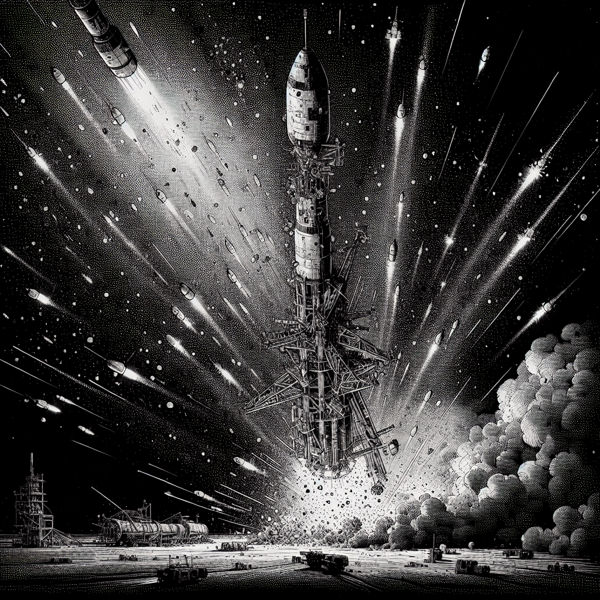
In Andrew’s absence, Justin Robert Young and Brian Brushwood tackle the recent SpaceX launch hiccup, where a ‘very rare glitch’ led to an unscheduled disassembly mid-mission, potentially jeopardizing the Starlink satellites’ deployment. The duo then shifts gears to a speculative debate on the future of human genetic modification for space travel, pondering the ethical implications and societal acceptance of such advancements. Amidst these discussions, they touch on AI’s role in music creation, sharing anecdotes and opinions on its evolving presence in the arts.
Picks:
Episode Notes
The episode opens with Justin and Brian discussing a New York Times story about a SpaceX Starlink launch that experienced an upper-stage problem. They note that the first stage landed normally on a drone ship, but the second stage did not reach the intended altitude to deploy the satellites properly, and they mention SpaceX describing the event as a very rare glitch and a rapid unscheduled disassembly.
The middle of the episode becomes a long speculative conversation about frontier life, space colonization, and genetic modification. They use William Shatner’s reaction to seeing Earth from space, Andrew Heaton’s Oklahoma land-rush family story, and examples like golden rice to argue that people would be slow to accept genetic editing unless harsh reality forced the issue over multiple generations.
The latter half turns to AI music, with Justin describing a real-life anecdote involving Robert Rodriguez and Udio, then both hosts discussing AI music tools, their quality, and the lawsuits against Suno and Udio. They compare AI training to temp tracks and musical influence, and near the end they transition into picks, with Brian mentioning House of the Dragon and Justin recommending Fargo season five.
Key topics
- Starlink deployment trouble after an upper-stage anomaly: They discuss a SpaceX rocket where the first stage landed successfully but the second stage failed to reach the proper altitude for Starlink deployment. The conversation includes speculation about whether the payload might still reach usable orbit.
- Rapid unscheduled disassembly / RUD jargon: Brian explicitly uses SpaceX's euphemism 'rapid unscheduled disassembly' while describing the malfunctioning second stage.
- SpaceX launch reliability and rarity of the failure: Justin notes that the malfunction appears to be the first of its kind in many years and emphasizes that SpaceX has a long record of successful launches.
- William Shatner’s emotional description of space: Brian recounts a Q&A with William Shatner in which Shatner described space as a place that made Earth feel precious, and Justin paraphrases that as seeing 'death' in space and life on Earth.
- Space as a frontier requiring slow, hard infrastructure: They talk about slow interplanetary travel, cosmic rays, low gravity, pressurized tubes on Mars, and the idea that future space settlement would be hard, practical, and not romantic.
- Resistance to genetic modification in a space-colony future: Justin argues that broad acceptance of genetic editing would require years of suffering and repeated failure before people would turn to it as a normal solution.
- Golden rice as an example of genetic-modification resistance: They mention golden rice to show that even beneficial genetic modification can face cultural and legal resistance.
- Jokes about robots and The Last Starfighter: The conversation briefly veers into jokes about people already writing defenses of sex with robots and a riff on The Last Starfighter and an Excalibur protocol.
- AI music as a creative tool for temp tracks and commercial work: They discuss AI music as useful for inspiration, temp tracks, and fast generation of cues for commercials, TV, and films.
- The legal dispute over AI music training data: They note that Suno and Udio have been sued by major record labels over alleged use of copyrighted material for training, and they discuss possible licensing or court outcomes.
- Ethics of automation versus human artistry: Brian frames AI as a mirror of what it was trained on, while Justin argues that learning creative tools still matters because people need to know how to direct outputs.
- Temp tracks and musical influence in film scoring: They use Star Wars and Holst's Mars as examples of temp tracks shaping final music, drawing a parallel to the ethics of AI-generated music.
- AI as a practical shortcut for everyday tasks: Justin broadens the discussion to mundane web and admin tasks, saying AI will likely first be useful for time-consuming digital chores.
Picks
- Brian Brushwood: House of the Dragon — Brian gives a casual recommendation centered on the spectacle of dragon fighting, noting that if you want to see dragons fight, the show delivers.
- Justin Robert Young: Fargo season five — Justin clearly names Fargo season five as his pick and praises it as highly cartoonish, moralistic, and entertaining.