A Deep Dive into Space, Technology, and Woolly Mammoths
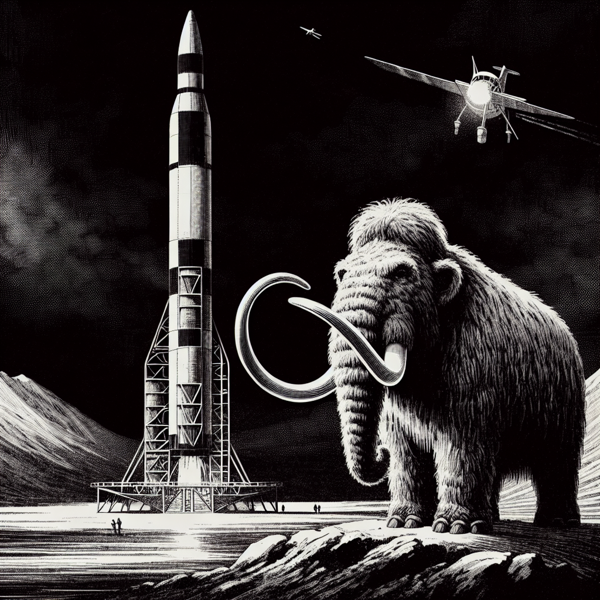
In this episode, Andrew Mayne, Justin Robert Young, and Brian Brushwood kick things off with a chat about SpaceX’s upcoming Starship launch and the company’s approach to failure as a step towards innovation. They delve into the history of space travel, highlighting the Space Shuttle’s design compromises and the importance of testing. The conversation shifts to Apple’s VR headset, with Brian sharing his mixed feelings about its practicality and Apple’s missed opportunity to create compelling content for spatial computing. The trio then explores the ambitious project of resurrecting woolly mammoths by Colossal Biosciences, discussing the scientific and ethical implications. Lastly, they touch upon the intriguing possibility of naturally occurring hydrogen production within Earth, which could revolutionize energy sources.
Picks:
Andrew: Plasma Channel on YouTube
Brian: Dune Part Two
Episode Notes
The episode opens with a long discussion of SpaceX test launches and the broader idea that visible failures are part of iterative engineering. Andrew and Brian contrast that with the Space Shuttle program, noting that shuttle design involved practical compromises, unexpected hazards, and a much messier reality than the idealized version often told. They also briefly touch on the value of publicity and storytelling in aerospace, including drone ship landings and fairing recovery attempts.
The conversation then shifts to the Apple Vision Pro, which Andrew describes as an impressive demo but a compromised device lacking a compelling everyday use case. After that, the episode moves through several science and tech topics: early nonlinear video editing systems like Edit Droid and Avid, de-extinction efforts around woolly mammoths and proxy mammoths, dinosaur DNA preservation and decay, Europa's oxygen uncertainty, and naturally occurring hydrogen or 'white hydrogen.' The episode ends with picks and recommendations, including The Plasma Channel and Brian's enthusiastic reaction to Dune Part Two.
Key topics
- SpaceX's failure-driven development model: They discuss SpaceX as an example of iterative engineering where failures are visible and expected, rather than hidden. The contrast is drawn against more traditional aerospace development.
- Shuttle-era engineering compromises and risk: The Space Shuttle is described as an extraordinary but highly compromised system, with issues including booster design constraints, temperature-sensitive O-rings, ice damage, micrometeorite concerns, and the need to coast down rather than fly like an airplane.
- Novelty as a public-relations strategy in aerospace: Brian argues that SpaceX's unusual recovery and landing attempts generated a lot of free storytelling, even when the economics were questionable.
- Apple Vision Pro's missing killer app: Andrew argues that Apple shipped a strong demo without the kind of standout app or workflow that would make spatial computing feel essential.
- Historical origins of nonlinear video editing: Edit Droid, Lucasfilm's Droid Works, Diva, Avid, laserdiscs, work prints, and proxies are discussed as part of the history of nonlinear editing.
- De-extinction ethics and ecosystem restoration: The mammoth discussion includes proxy mammoths, Asian elephants as surrogates, potential ecosystem effects, and ethical concerns.
- Nature versus nurture in resurrected animals: They debate whether a proxy mammoth's behavior would come from genetics or from environment and learning.
- DNA preservation and reconstructing ancient genomes: Andrew discusses preserved proteins, chromosomes, chemical markers, and the idea that unusual preservation conditions may allow more ancient DNA to survive than standard half-life estimates suggest.
- Europa’s habitability and oxygen uncertainty: They talk about reports of lower-than-expected oxygen on Europa and note that the subsurface ocean and ice shell leave many unknowns.
- Natural hydrogen generation on Earth: The hosts discuss naturally occurring hydrogen, including the term 'white hydrogen,' and possible geochemical sources on Earth.
- Plasma-based experiments and educational science content: Andrew recommends The Plasma Channel for its demos involving plasma, high voltage, fusion-related experiments, and practical science explanations.
- Dune adaptations, especially Part Two: Brian strongly praises Dune Part Two, while Andrew says he is excited to see it but prefers home viewing when theaters have poor presentation.
Picks
- Brian Brushwood: Edit Droid, The Rise and Fall — Brian explicitly says he wants to find the documentary and watches it as a recommendation-worthy item, though he does not fully describe it as a formal pick.
- Andrew Mayne: The Plasma Channel — Andrew explicitly recommends the channel, calling the creator a great explainer and saying he highly recommends it for learning about plasma and high-energy physics.
- Brian Brushwood: Dune Part Two — Brian gives a clear positive recommendation, saying he loved it, that it was highly recommended, and that it was 'way good.'