Making Star Trek Possible: Warp speed without the warp drive
A five-part series that tries to explain how to make the science of Star Trek real…
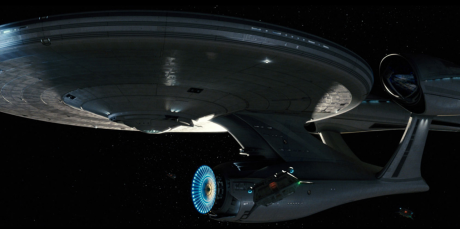
Probably the most fascinating idea that Star Trek popularized was the idea of a warp drive. This was a concept from golden age sci-fi that went mainstream via Trek as space-age audiences became sophisticated enough to realize that NASA’s fastest rockets wouldn’t take you very far in a human lifetime. Even going the speed of light wouldn’t work for a show that tried to visit more than one star system in it’s 3 season run (due to time dilation your characters could visit those places, but their friends back on earth would be long dead). What was needed was a (plot) device that allowed you to visit distant planets in the time it takes to drive to the next state.
Since Star Trek, warp drive has become a part of public consciousness. It’s a theoretical form of technology that some feel is as inevitable as AI and teleportation.
There’s one big catch; while AI (or something that acts like it) seems to be a problem solved at some point on a graph projecting the development of intelligent systems and teleportation seems to be more of an energy problem, there’s not a viable theory for how a warp drive could work (exotic matter, worm holes, Alcubierre drives etc.) that doesn’t violate the laws of physics (as we know them) or result in some equation balancing phenomenon like a “quantum scream” (an obscure term used in an equally obscure paper on the subject).
But despair not. There could be a much simpler solution to getting to faraway planets quickly in a short amount of time. It might have to do with the fact that when we look at distant galaxies or study the acceleration of space probes beyond our solar system we see some strange stuff that falls outside our theoretical framework. Galaxies are moving faster than they should. Our space probes seem to be accelerating faster than they should (although this one might be just a measuring problem). There’s a variety of theories to explain this. None of them dominate.

If space itself is dimpled like a golf ball, traveling in a straight line is usually not the best option to get from one point to another. The fastest path is the one that avoids going into the valleys created by the dimples – but not too far out of the way.
Every particle in the universe makes a dimple in space. This dimple effects matter and light. Light from our second closest star is slowed down ever so slightly by the dimples caused by the various particles between it and us. Even a total vacuum suffers quantum fluctuations that cause these dimples.
Depending upon how significant the effect this dimpling has and how much it occurs on a galactic scale, we might have to rethink how we measure distance between stars. A star five light years away might be reachable in less time going less than the speed of light if there was a way to take a route that avoided most of the dimpling. This might be a route only a subatomic particle could take and it might only shave.0000000000000001 milliseconds off the total trip time, but it’s a start. And if it turns out that those dimples have dimples, then there might be an even bigger time savings.
While that’s not a whole lot to hope for right now and nowhere near as sexy to think about as a magical warp engine, it’s a helpful frame of reference for understanding how faster than light travel may not mean going faster than the speed of light.
Finding a way to get to distant star systems might not come from waiting for our existing theories to be overturned to satisfy our wishes. It might just come from studying the phenomenon at hand and better understanding how it all works together.
Check out the rest of the series on making the science of Star Trek possible